
With Hamas refusing ceasefire extension, Israel suspends all humanitarian aid to Gaza
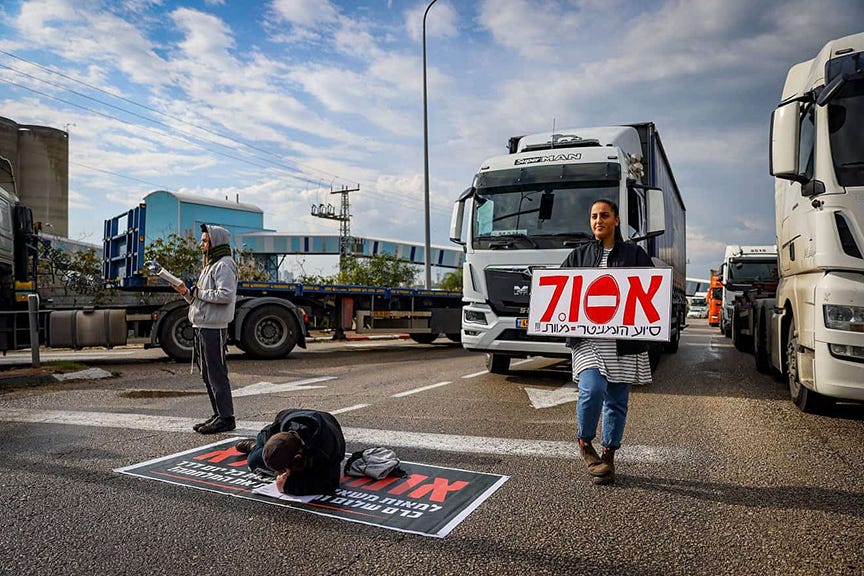
The entrance to Ashdod Port is blocked during a protest against aid trucks entering the Gaza Strip, Feb. 1, 2024. Photo by Chaim Goldberg/Flash90.
by Joshua Marks
(JNS) — The Israeli government announced on the morning of March 2 that it has suspended all humanitarian aid to Gaza after the Hamas terrorist organization rejected the ceasefire extension proposed by U.S. Middle East envoy Steve Witkoff.
Israeli Prime Minister Benjamin Netanyahu announced that no goods or supplies would enter Gaza until further notice, reaffirming that Jerusalem will not agree to a ceasefire without the release of its hostages.
Since the ceasefire began on Jan. 19, 25,200 aid trucks carrying food, water and medicine have entered Gaza, alongside more than half a million tents and 2,100 fuel tankers. Israeli officials estimate that Hamas has stockpiled supplies sufficient for four to six months.
Hamas insists on moving to Phase 2 of the ceasefire, which includes talks on a permanent end to hostilities, Israeli military withdrawal from Gaza, reconstruction and a prisoner-hostage exchange.
Hamas responded to the Witkoff framework, which was adopted by Israel, by stating: “The only way to bring back the hostages is to complete the agreement” by moving to Phase 2. The terror organization also sent a message ahead of last week’s Cairo summit that it rejects any non-Palestinian governance and opposes the presence of foreign forces in Gaza.
Under the U.S. proposal, half of the remaining hostages (living and deceased) are to be freed on the first day of the extension; the rest will be released if a permanent ceasefire is agreed upon.
The framework was accepted by Israel following a high-level security meeting on the night of March 1. Under the proposal, the extension, which is to last 42 days, through the Ramadan and Passover holidays, may be further extended to facilitate negotiations.
If talks prove ineffective, Israel retains the right to resume military operations after 42 days, a condition backed in a side letter by the previous Biden administration and supported by the current Trump administration.
The Washington Free Beacon reported on Feb. 28 that Jerusalem is preparing to resume the war in Gaza in four to six weeks. This “decisive” campaign, aimed to wipe out Hamas, could be paused if the terrorist group’s leadership agrees to free hostages, or agrees to disarm and go into exile, the report added.
Amid the ongoing uncertainty with regard to the situation in Gaza and the region generally, Israel’s government on March 2 approved an extension of legislation allowing the call-up of 400,000 reservists.
Ramadan started the night of Feb. 28 and runs until March 29, while Passover begins on April 12 and ends on April 19.
Israeli assessments indicate that Palestinian terrorist groups in Gaza are holding 59 hostages. Of these, 24 are believed to be alive—all men—while 35, including three women, are believed to be deceased. Two of the living hostages and three of the deceased are foreign nationals.
Update on March 3: The United States has given its support to Israel’s announcement that it is suspending all humanitarian aid to Gaza after the Hamas terrorist organization rejected a ceasefire extension proposed by Washington.
“Israel has negotiated in good faith since the beginning of this administration to ensure the release of hostages held captive by Hamas terrorists. We will support their decision on next steps given Hamas has indicated it’s no longer interested in a negotiated ceasefire,” U.S. National Security Council spokesman Brian Hughes told Axios on March 2.
The European Union condemned Hamas’s refusal to extend Phase 1 of the ceasefire but also warned of the humanitarian impact of Israel’s decision to stop aid shipments.
Meanwhile, Qatar, despite its role as a mediator between Israel and Hamas, issued a strong condemnation of Israel’s move, calling it a violation of the agreement and international humanitarian law. Another mediator, Egypt, also criticized the Israeli decision. “Using aid as a weapon of collective punishment and starvation in Gaza can’t be accepted or permitted,” said Egyptian Foreign Minister Badr Abdelatty.
According to Hebrew media reports, additional measures under consideration by Jerusalem include cutting off electricity and water supplies, targeted strikes on Hamas assets, blocking the entry of temporary shelters and heavy machinery for rubble clearance, and maintaining Israel’s presence along the Philadelphi Corridor.
Moving the Gazan population from the north to the south of the Strip again and resuming the war at full force are also being considered.