
The problem with media discourse on the Iran war and "international law"
Spoiler alert: Unlike domestic law in each country, there is no such thing as "international law" that can be enforced globally or interpreted universally
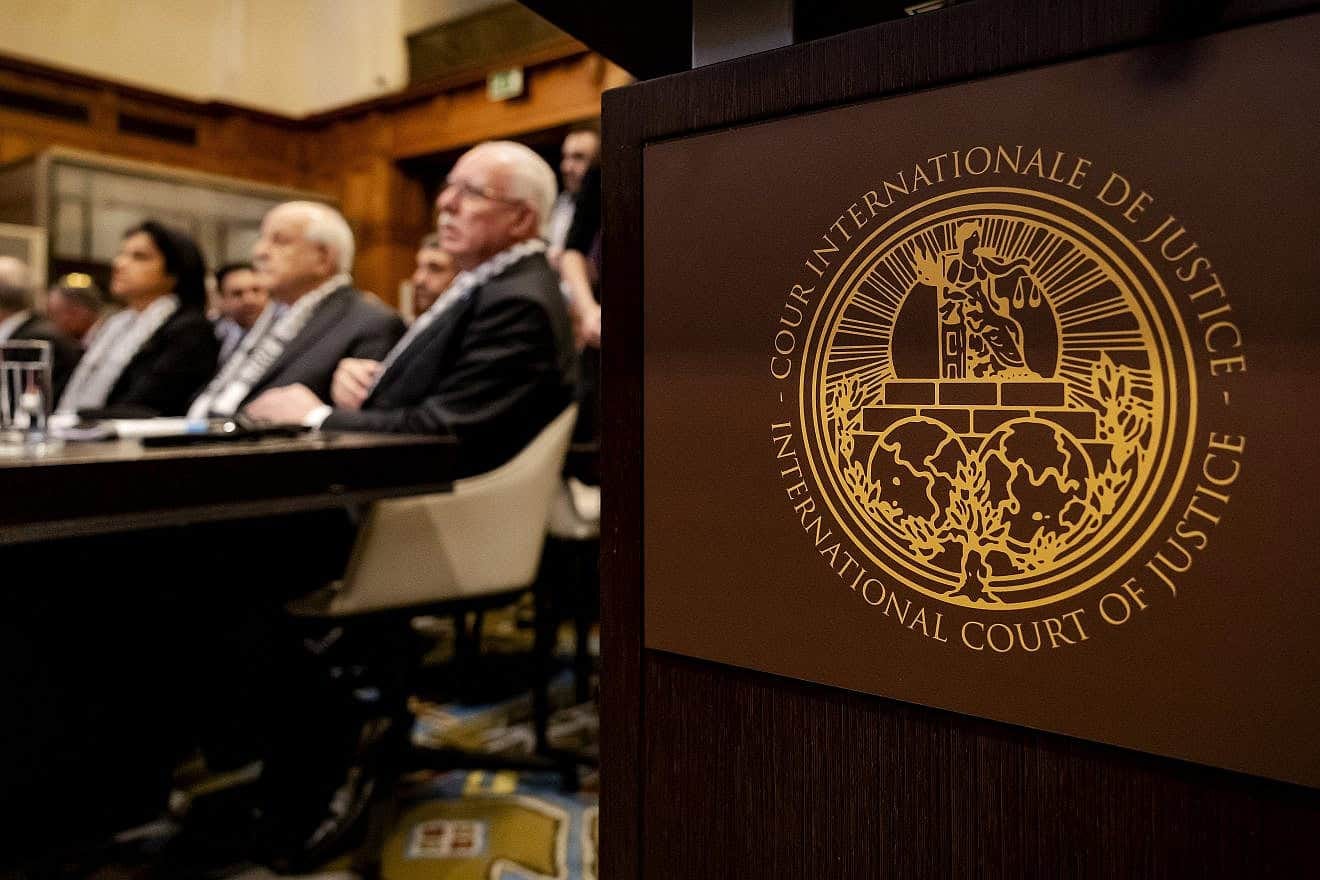
Palestinian Authority diplomat Riyad al-Maliki and members of his delegation at the International Court of Justice in The Hague, Feb. 19, 2024. Photo by Robin van Lonkhuijsen/ANP/AFP via Getty Images.
by David Litman
(CAMERA) — In the opening few minutes of my law school course on international law, my professor began with perhaps the most telling opener possible: declaring that “international law is real law.” It was what younger generations might think of as an attempt at “self-manifestation,” or the field of international law insisting upon itself.
I prefer to explain the field with a movie analogy, as fraught and cliché as that may be. The first Pirates of the Caribbean movie helpfully illustrates the perils of “international law” discourse in the mainstream media amidst the war with the Iranian regime.
In the movie, Elizabeth, the female protagonist, finds herself captive on a pirate ship, the Black Pearl. She makes a bargain, relying on her vague understanding of the Pirates’ “Code of the Order of the Brethren,” and gives away her sole source of leverage – a cursed medallion – in exchange for the pirates ending their attack on her town. The pirates cease their assault but decide to kidnap Elizabeth, who is now powerless. When she protests, citing the Code, the pirate Captain Barbarossa responds with the infamous line, “The Code is more what you’d call ‘guidelines’ than actual rules. Welcome aboard the Black Pearl, Miss Turner.”
The analogy is more apt than one might first think. Concepts like “universal jurisdiction” – the idea of an “international crime” for which any state could prosecute perpetrators – emerged from efforts to fight piracy.
The reliance on individual states for prosecution was necessary, of course, given that there was no international law enforcement body, which remains true today. Without law enforcement, law becomes mere guidelines.
But there’s another fundamental flaw relevant to the world of mainstream journalism. There is no one true interpretation of what international law mandates, regardless of what “experts” at outlets from the Washington Post to the New York Times to Deutsche Welle claim.
Despite its official-sounding name, the International Court of Justice’s (“ICJ”) own statute prevents it from making interpretations that bind anyone or any situation outside of an immediate dispute, making it akin to a glorified arbitration panel. Often, even the parties to the immediate dispute ignore the ICJ’s rulings, too. Journalists have also demonstrated an inability to accurately understand the ICJ’s rulings, anyway.
At the end of the day, as even the ICJ implicitly admits, the only interpretation that matters is that of individual states themselves, not those of self-important “international law experts.” Moreover, one state’s interpretation cannot – legally or practically – bind any other state. The United Nations (“UN”) is composed of 193 countries: that’s 193 different possible interpretations of the same vague rules. Sure, a majority can agree on one interpretation, but the minority are still entitled to disregard that interpretation. Popularity contests in the form of votes on non-binding recommendations at the UN are meaningless, especially because states regularly contradict their own positions. Even where a UN Security Council resolution is considered legally binding (most aren’t), those decisions are generally limited to specific situations.
This leaves states in the same position as Elizabeth on the Black Pearl. They can appeal to the “Code,” but there are no pirate police to enforce the rules, of which the pirate captain may have entirely different interpretations, anyway.
Understanding how all of this works is critical given the narratives floating around in mainstream media about U.S. and Israeli strikes on the Iranian regime supposedly violating “international law.”
The Iranian regime has, since its inception in 1979, pursued the export of its radical, revolutionary and religious ideology throughout the region. It has built and supported terrorist proxies like Hezbollah to attack Israel while holding the entire Lebanese nation hostage. So, too, have its proxies in Iraq, who have similarly worked to ensure the Iraqi people remain beholden to Iranian masters. The Ayatollah sent both fighters and weapons to help Bashar al-Assad’s brutal regime butcher his own people. The Iranian regime has trained and equipped the Houthi terrorists who have similarly slaughtered their fellow countrymen, threatened their Gulf Arab neighbors, and wreaked havoc on international shipping, all while espousing the motto: “God is great, death to America, death to Israel, curse the Jews, and victory for Islam.”
This is an aggressive, militaristic regime hellbent on bending the region to its oppressive rule through threats and violence. Even as the country is running out of money and water, the regime chooses instead to spend greater amounts of the nation’s wealth on supplying armed terrorist groups abroad, pursuing nuclear weapons, stockpiling thousands of ballistic missiles, and threatening the entire Middle East.
To heed the demands of international law intelligentsia would mean being effectively helpless against the threat.
Among the academics and activists featured across the media, there is a prevalent view that a state may not act in self-defense until attacked, and even then, the self-defense must be limited only to beating back the immediate attack, not eliminating the threat.
Others would allow for preemptive defensive action, but only once a threat has grown sufficiently grave and imminent. They insist defensive action must wait until the threat has sufficient strength, thereby ensuring the inevitable conflict is even bloodier than it otherwise would have been. Israel must wait until Iran is mere minutes from a nuclear weapon. The United Arab Emirates couldn’t act as Iran builds up stockpiles of thousands of ballistic missiles; it must wait until the launchers are in position.
Militarily, this is suicidal.
Even when a state is attacked, many in the intelligentsia would still deny a right to self-defense. The ICJ has denied states a right to self-defense against non-state actors like Hamas, Hezbollah, or ISIS. This gives Iran a perfect loophole: it can use ideologically aligned proxies to fight its battles without running afoul of the rules. True, the intelligentsia acknowledge a state may sometimes be held responsible for the acts of a proxy force, but even that standard is easily circumvented. The ICJ would require that a state have “overall” or “effective” control of the non-state actor to be liable. But control isn’t necessary for Iran’s purposes when third parties are ideologically aligned. Absent Iranian support, these terrorist groups across the region couldn’t wage their armed campaigns nearly as effectively. But this interpretation of “international law” would force victim states to grin and bear it while Iran and its proxies wage war on them.
Of course, many states and scholars reject these interpretations. But mainstream media outlets conveniently platform only those who espouse these unserious interpretations as definitive restatements of “international law.” For an already complex subject, this pattern only sows further confusion among media consumers as to what international law really says, compounded by uninformed politicians who repeat these talking points, creating a news cycle within a news cycle.
Activists, bureaucrats, and propagandists exploit this confusion. Consider the recent sinking of an Iranian warship by a U.S. submarine. Journalists and propagandists – from the Iranian foreign minister, Abbas Araghchi, to Mehdi Hasan’s Zeteo News, to Alan MacLeod at the propaganda rag MintPress News – have advanced the ludicrous idea that the sinking was illegal, and even a “war crime,” because it occurred in “international waters.”
Of course, there is no prohibition on sinking enemy vessels in international waters.
But if “international law” would be so absurd as to deny the United States its right to self-defense against al-Qaeda after the September 11 attacks, or Israel after the October 7 massacre, then it’s not much more of a stretch to believe that had the U.S. Navy spotted the Japanese fleet on its way to Pearl Harbor in December 1941, “international law” would prevent it from acting until the fleet entered territorial waters.
The world today is full of Captain Barbarossas who exploit the ambiguities and powerlessness of “international law.” Worse, knowingly or otherwise, the media has acted to run cover for them and even legitimized their exploitations. Let Elizabeth’s mistake in trusting mere guidelines be a lesson to media consumers. Avoid the Black Pearl bargain.
Originally published by the Committee for Accuracy in Middle East Reporting and Analysis.