
The difference 36 hours makes
Large group from International Christian Embassy Jerusalem had ceremony at Be'eri Forest by Gaza. Two days later, Hamas invaded there.
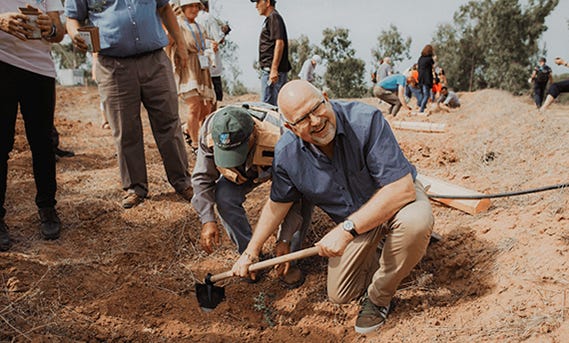
Just 36 hours earlier… Planting trees in the Be’eri Forest at the new Christian Embassy Nature Park on Oct. 5.
October 7 ushered in “a new era on the importance of standing with the Jewish people,” said Chris Mitchell, Jerusalem bureau chief of the Christian Broadcasting Network, at an NRB forum on the future of U.S. and Israel relations from a Christian and Jewish perspective.
He said, “I’ve never seen the Jewish people feeling so alone, so isolated” by the world’s response to the Oct. 7 invasion and Israel’s attempts to uproot Hamas from Gaza.
Juergen Buehler, president of the International Christian Embassy Jerusalem, said that they had over 3500 pilgrims in Israel for Sukkot the week before the attack, and just two days earlier, a delegation of about 700 from over 50 countries went to the Gaza envelope for a celebration. “We didn’t have any inclination something would be coming up within 36 hours,” he said.
They were in the area on Oct. 5 for a solidarity gathering with the Israeli communities who had been living under constant threat of rockets from Gaza. With representatives of Keren Kayemeth LeIsrael-Jewish National Fund, they dedicated a section of the Be’eri Forest that had burned in recent years. The 126-acre section was renamed the Christian Embassy Nature Park.
For all our NRB convention coverage, click here
The forest was among the areas burned by incendiary balloons and kites launched from Gaza into Israel, with the express purpose of causing wildfires. KKL-JNF had planted thousands of dunams of trees along the Gaza border over the decades, only to see 70 percent of these forested areas scorched by the rash of Palestinian arson attacks since 2018.
The delegation also visited some of the over 140 bomb shelters that ICEJ donated in the region, and held a rally and security briefing at the Sha’ar HaNegev Regional Council near Sderot, 10 miles from Be’eri.
They “felt an incredible presence of God there,” Buehler said. “Thirty-six hours later, the streets we were driving on became killing fields.”
Be’eri Forest starts just a few hundred feet from the Gaza border and is between Gaza and Kibbutz Be’eri, which became one of the focal points of the Hamas attack on Oct. 7. Over 110 residents of Be’eri were murdered, and 23 were taken hostage.
In March the Czech branch of ICEJ donated a fully-equipped military ambulance to serve the area, part of a campaign to replace dozens of ambulances that were destroyed on Oct. 7 and after. The ICEJ fundraiser was sparked by footage of Hamas gunmen shooting up an ambulance during their attack on Kibbutz Be’eri.
Among the speakers at the ICEJ rally on Oct. 5 was Ofir Libstein, head of Sha’ar HaNegev. Buehler tried to call him after hearing of the attack, but he soon found out that Libstein was the first confirmed fatality in the Hamas attack, along with one of his four children.
Buehler said the Hamas killing spree was “demonic” and “you were really looking at the face of Satan… I didn’t even think animals would do that.”
And yet, “before any Israeli soldier put a foot in Gaza, there were tens of thousands of people in the streets” around the world, protesting the notion of any Israeli response.
He added that “it is very important that Israel has the support of the U.S., that they finish the job, that they not negotiate with terrorists.”
Buehler’s son is among the soldiers in Gaza, and reported that the soldiers can feel that there are people praying for them. He also reported that he had been in life-threatening situations, and “either Hamas is the worst shooters, or God is protecting me.”
Joel Rosenberg, editor in chief of All Israel News, said Hamas had a long-term plan to feign cooperation and progress — “Make Israel feel secure, then invade them.”
The plan was “not to just kill everybody but take hundreds back because then they won’t invade, they’ll have to surrender.”
Instead, Israel launched a major response as Hamas threatened to repeat Oct. 7 until the Israelis leave the region.
Mitchell said the network of terror tunnels that Hamas built throughout Gaza have shafts “in supermarkets, schools, mosques and homes.”
He saw a terror tunnel in Khan Yunis, with a leadership center 75 feet underground, likely where Hamas leader Yahya Sinwar had been at one point. There was also a room with a cage, and he said that is where 12 hostages had been held.
Mitchell said he is also praying for the Palestinian people, “to be free of the tyranny under Hamas.”