
Getting a first-hand view
A National Religious Broadcasters fact-finding mission to Israel expresses solidarity
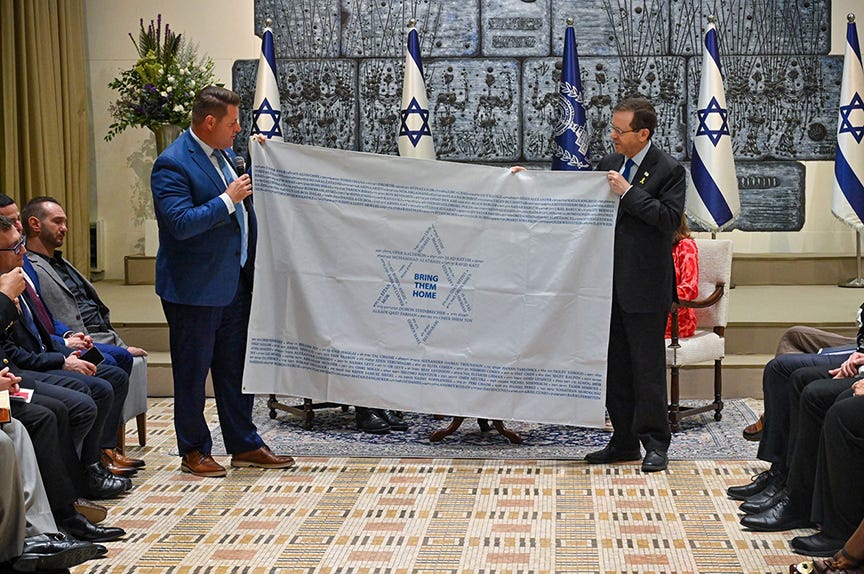
Jim Scudder, Jr., of InGrace Ministries, presents Israel President Chaim Herzog a “Bring Them Home” flag with the names of Israeli hostages in Gaza. Photo by Kobi Gideon/GPO
The National Religious Broadcasters, the world’s largest association of evangelical Christian communicators, led a solidarity mission to Israel to learn first-hand about the war against Hamas and the aftereffects of the October 7 invasion from Gaza that led to the massacre of 1200 Israelis.
Troy Miller, president and CEO of NRB, organized the trip, which was announced at NRB’s convention in February and took place in late May. The mission was “to find out what is going on, what is the mood, what is the real story as compared to what we see in the mainstream media.”
While the news is filled with video from anti-Israel demonstrations in cities and college campuses, leading Israelis to feel isolated, “we wanted to bring a message, ‘that’s not true,’ there are lots of American evangelicals that are praying for and supporting Israel’s right to defend themselves.”
The trip was done in collaboration with Keep God’s Land, Israel365 and the Jerusalem Prayer Breakfast. There were briefings from Israeli government officials, and visits to key sites and with Israeli communities, focusing on life in Israel during and after October 7.
Miller said this was the first of what he hopes will be an annual solidarity and fact-finding trip.
The delegation started the week-long visit with a briefing from the Ministry of Foreign Affairs, learning about diplomatic efforts. They had the opportunity to participate in a blood drive with Magen David Adom, which has an annual presence at the NRB convention, and toured the Knesset, Israel’s parliament. They also visited the underground emergency hospital at Hadassah on Mount Scopus.
Eitan Na’eh, Israel’s ambassador to Bahrain, gave a briefing about the Abraham Accords and current relations with Arab countries. They also met with a Bedouin tribe to learn about their role in Israel, and how their youth volunteer to serve in the Israel Defense Forces.
Additionally, the group saw how there is a large population of Arab Israelis, with “a lot of comraderie and support between the communities.”
Miller added that the Jewish and Arab communities “can live in peace, it has been proven. It’s the radical Islamists who want to disrupt that.”
The delegation went toward the Gaza envelope and visited the “car graveyard,” with over 1600 destroyed cars of victims of the Hamas massacre. They met with the volunteer response group ZAKA, which was tasked with retrieving all human remains from the cars.
They also visited some of the border communities affected by the massacre, learning about the challenges they face in rebuilding, and also visited the Nova music festival site, which has become a grassroots memorial.
In Tel Aviv, they saw Hostages Square, where the Hostages and Missing Families Forum keeps their plight in front of public consciousness. Families of three hostages had shared their story at this year’s NRB convention.
The delegation was also able to enjoy a traditional Shabbat dinner in Jerusalem. There was also a dinner with Israel Minister of Tourism Haim Katz, who was at the NRB convention.
One day was spent in the territories, learning more about the Keep God’s Land initiative, which had been unveiled at the convention. Miller said the initiative is “to really help people be aware of what we are talking about. Words and language are so important.”
To that end, at the convention earlier this year, Christian broadcasters were urged to drop the term “West Bank” and refer to the areas by their Biblical names, Judea and Samaria. Miller said the term West Bank conjures up an image of something other than Israel, but “this is historical Israel, this is where Jesus walked… this is part of the land God carved out when he promised it to Abraham.”
In visiting Samaria, Miller saw just how small Israel truly is. “You’re up in the Samaria hills and you can see all the way to the Mediterranean,” he said. “You understand what Israel would be giving up in security if those areas were turned over to the Palestinians or the Islamists who are bent on the destruction of Israel.”
Being in the territories also showed a perspective of Israeli life that is completely absent in mainstream media. “When you visit the Jewish communities, they have to have security fences around them, guards at the gates to protect their community, but you don’t see the same thing in the Arab communities, they’re not threatened at all by the Jewish communities, and you don’t see that at all in the media.”
At the president’s residence, Jim Scudder, Jr., of InGrace Ministries, presented Israel President Chaim Herzog with a flag of Israel with the names of hostages in Gaza forming the stripes and the Star of David. Miller said the flag was designed by Scudder’s church and presented “as a symbol to show the churches in America haven’t forgotten about Israel, and haven’t forgotten about the hostages, and they remain high on our list of prayers.”
Herzog called it “A meaningful and beautiful show of solidarity for our hostages” and “a moving token of support from Christian friends of Israel from all over the world.”
The group also visited a military base where reservists were training for anticipated action along the Lebanese border, where over 100,000 Israelis have been evacuated from their homes due to persistent rocket fire from Hezbollah.
Miller said he was impressed by the soldiers’ resilience and their desire to protect their communities. “It’s not like you’re going off to a foreign country to fight, it’s in your back yard.”
Upon returning to the U.S., Miller said “Israel has made clear that its conditions for a ceasefire are the destruction of Hamas, the freeing of all hostages, and certainty that Gaza no longer poses a threat to Israel. Israel is our most important ally in the Middle East and should have international support in acting in the best interest of its own citizens, including those being held hostage in Gaza.”
What Christians can do
Miller said Christians should continue to pray for Israel, especially for the soldiers defending the state, and for the return of the hostages still in Gaza.
The group “heard loud and clear” from Israelis and from American Jews they encountered in Israel how Israel feels isolated and alone, as do American Jews. “If you have a Jewish community near you or your church, reach out to them” to let them know there are Christians who support them.
Similarly, the large number of anti-Israel demonstrations on campus have left Jews feeling isolated and threatened. “If you are part of a Christian organization on campus, reach out to your fellow Jewish students, that they are not alone, they are loved and cared for.”
There are also practical things for Christians to do in Israel. Miller said traditional “holy land experience” trips are on hold, but churches are always doing service trips elsewhere in the world. This is the opportunity to have a service-oriented trip to Israel, he said. “A lot of these kibbutzim in the south need help cleaning up and rebuilding the communities,” he said. “A lot of their workers were foreign workers who went back or can’t come to help.”